Cramped living rooms don’t have to feel cramped. If you’re wrestling with an awkwardly shaped or undersized living area, a sectional might be the answer, but only if you pick the right one. Unlike traditional sofas, sectionals for small living rooms can wrap around corners, tuck into tight spaces, and actually make a room feel larger by anchoring the layout efficiently. The trick is understanding which configurations work in compact spaces, how to measure correctly before buying, and what trade-offs exist between comfort and footprint. This guide walks through the practical decisions you’ll need to make.
Table of Contents
ToggleKey Takeaways
- Sectionals for small living rooms wrap around corners and define space more efficiently than traditional sofas, using corner dead zones and creating intentional layouts without consuming extra square footage.
- Measure doorways, hallways, and room dimensions twice before purchasing—account for hinges, corners, and clearance; your sectional should occupy only 40–50% of floor space to maintain walkways and breathing room.
- Choose between L-shaped sectionals for durability and fixed layout or modular systems for flexibility and easier movement through tight spaces, depending on whether you value rearrangement options.
- A compact sectional in a small living room typically ranges from 72–90 inches on the long side for spaces under 150 square feet, with depth considerations critical to avoid blocking sightlines or pathways.
- Opt for performance fabrics in neutral tones, exposed legs, and reversible chases to maximize visual space perception and adaptability in compact living areas.
- Before committing, honestly assess whether your sectional will fit through doorways, leave adequate walkways, and actually serve your household’s seating needs rather than just filling empty space.
Why Sectionals Work Better Than Traditional Sofas for Compact Spaces
A standard sofa takes up linear floor space and doesn’t solve the corner problem, you end up with dead zones nobody uses. A sectional, by contrast, folds into corners and defines the room’s flow without eating extra square footage. It also offers more seating per square foot and can anchor a layout better, making the room feel intentional rather than cramped.
Beyond layout, sectionals give you flexibility. You’re not locked into a single orientation: a modular sectional can be reconfigured as your needs change. If you move, upgrade, or realize your layout wasn’t ideal, you can rearrange pieces instead of hauling an entire sofa to the curb.
There’s a catch: sectionals take longer to deliver, harder to move through doorways, and consume a significant visual footprint even when they’re space-efficient. If your living room doubles as a guest bedroom or has heavy foot traffic, a sectional might crowd things too much. That’s where honest assessment matters. Before you commit, ask yourself: Will this actually fit through my front door? Do I have the floor space, even accounting for walkways? Will I use all the seating, or am I just filling space? Sectionals for small living rooms only work if the answer to these questions is yes.
One more advantage: they’re excellent for creating defined zones in open-plan homes. A sectional can delineate your living area from a kitchen or dining space without requiring walls or dividers.
Essential Measurements and Space Planning Before You Buy
How to Measure Your Room and Doorways
Measuring is non-negotiable: skipping this step leads to expensive returns and frustration. Grab a tape measure, a notepad, and be thorough.
Start with your room. Measure the length and width of the living room, including any alcoves or odd angles. Walk around and note where windows, doors, outlets, and radiators sit. These aren’t just décor constraints, they affect traffic flow and wall space available for a sectional. A heating vent under a potential seating spot means poor comfort, and a door that swings directly into your seating area makes the space feel cramped.
Now measure your doorways and hallways, all of them. Measure the door frame width (not the door itself: hinges steal 1–2 inches) and the hallway width and length from the main entrance to your living room. Account for corners. A doorway might be 32 inches wide, but if your hallway narrows to 28 inches around a turn, that’s your real constraint. Call the furniture store and ask for the sectional’s assembled depth, width, and whether it needs to be unwrapped in the room. Some sectionals ship in one piece: others arrive as separate modules that you assemble on-site. Modules are easier to maneuver through tight spaces.
Draw a rough floor plan on graph paper or use a free app like MyDomaine’s design tools to sketch your layout. Mark your sectional’s footprint and check sightlines, can you see your TV without craning your neck? Is there a clear path from the entryway to other rooms?
Calculating the Right Sectional Size
Small living rooms typically range from 100 to 200 square feet. For a space under 150 square feet, you’re likely looking at a compact L-shaped sectional (around 75–90 inches on the long side) or a modular 2- or 3-piece setup. Anything larger than 90 inches in a tight room will dominate and limit walkways.
The rule of thumb: your sectional should occupy no more than 40–50% of the floor space, leaving 50–60% open for walking, other furniture (coffee table, accent chair), and breathing room. If your living room is 10 feet by 12 feet (120 square feet), a sectional using 48–60 square feet is appropriate. That translates roughly to an L with a 60-inch long side and a 36–40-inch chaise or return.
Depth also matters. Sectional arms and backs typically run 30–36 inches deep. A chaise (the angled lounge extension) adds another 24–30 inches. Measure from your sofa wall to the opposite wall: if it’s only 12 feet, and you subtract 3 feet for clearance on the far side, you’ve got 9 feet, which is tight. Test this by walking the proposed layout in your head or, better yet, tape a rough outline on the floor using painter’s tape.
Height is easy to overlook. If your living room has a low ceiling (8 feet), a tall sectional back or high armrests can feel oppressive. Conversely, if your ceiling is high (10+ feet), a low-profile sectional might feel adrift. Standard sectionals are 32–36 inches tall at the back: modern, lower-slung designs hover around 28–30 inches.
Also check leg clearance. A sectional with a low skirt or no legs (skirted base) looks heavier but feels less cramped. Exposed legs create a lighter visual impression and make room feel bigger. Confirm the manufacturer specifies wood frame (hardwood, not particleboard) and an eight-way hand-tied or sinuous wire suspension system for durability, these details matter for longevity, especially in compact layouts where you’ll use the seating more frequently.
Top Sectional Configurations for Small Living Rooms
L-Shaped Sectionals and Corner Designs
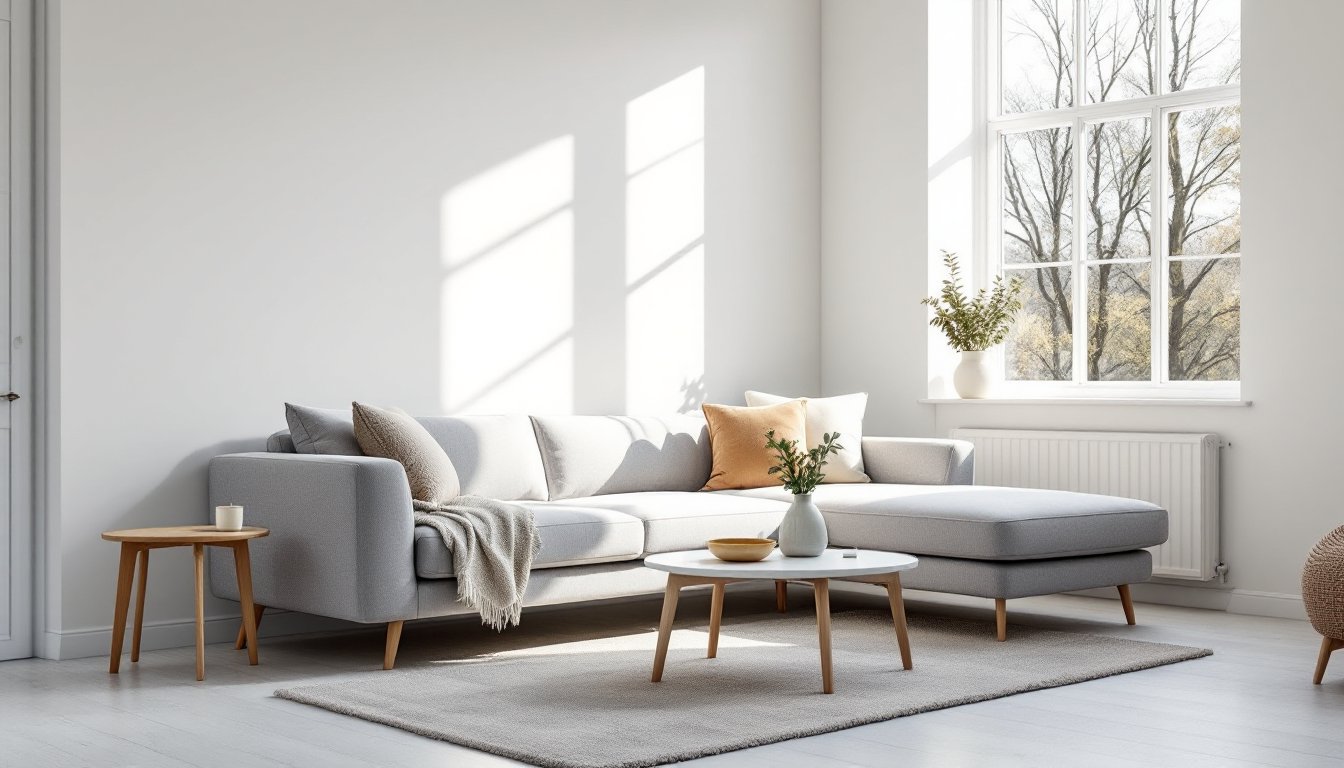
The L-shaped sectional is the workhorse for small living rooms. It uses corner space efficiently and seats 4–5 people comfortably without sprawling. A typical compact L, say 72 inches long and 54 inches deep on the return, works well in a 12×14-foot room.
When positioning an L-shaped sectional, place the long side against the longest wall and tuck the chaise or return into the corner. This anchors the room and maximizes corner utility. Avoid floating an L in the center of a small room unless it’s part of an intentional two-zone layout (e.g., living area in one end, dining in the other).
Corner sectionals are fixed, meaning they don’t reconfigure. They’re generally cheaper and sturdier than modular options, but they commit you to one layout. If you think you might rearrange later, modular is smarter even though the higher cost.
Look for corner sectionals with reversible chaises if possible, if your layout changes, you can flip the chaise to the opposite side. Also check whether the return (the short end without a chaise) is removable or fixed. A removable return gives you flexibility: a fixed return traps you into one config.
Modular and Apartment-Friendly Options
Modular sectionals are individual pieces that snap together or sit side-by-side. A typical setup might be a corner unit (like a 36×36-inch L), a single seat, and a chaise. You buy only what you need and add pieces later. They’re excellent for apartment dwellers and renters who can’t damage walls or commit to fixed furniture.
Modular systems are pricier per piece (often 15–25% more than a fixed L-shaped sectional of similar size), but you avoid the all-in commitment. If you move, you can reconfigure or leave pieces behind. Brands like Article, Article (mentioned by Apartment Therapy as a go-to for space-conscious buyers), and more affordable options through online retailers offer modular styles starting around $800–1,200 for a basic 3-piece configuration.
For apartments and small rentals, look for sectionals with:
- No-tool or minimal-assembly connection systems (interlocking legs, brackets, or magnets)
- Compact footprints (avoid pieces over 85 inches unless your space is genuinely large)
- Washable slipcovers (accidents happen, and renters often can’t reupholster)
- Light-colored fabrics (they hide dust less but feel spacious: dark fabrics make compact rooms feel smaller)
A popular design approach highlighted on Domino for small apartments is pairing a compact 2-piece sectional (corner unit + single seat) with a small ottoman, total footprint under 8×8 feet, seats 3–4 people, and the ottoman doubles as a coffee table or extra legroom.
Fabric choice affects both durability and perception of space. Microfiber and performance fabrics (treated polyester blends) resist staining and work well in high-traffic households. Linen and light cottons feel airy and expand the visual space but require more maintenance. For small living rooms, a mid-weight performance fabric in a neutral tone (gray, beige, cream) is the practical sweet spot.
Making the Right Choice
Sectionals for small living rooms succeed when measurement, configuration, and honesty about your space align. Take time to measure everything twice, sketch your layout, and envision daily use. A perfectly sized, well-placed sectional feels generous and anchors the room: an oversized or awkwardly positioned one suffocates the space and ends up resented.
Start with your doorways and hallways, then work backward to sectional size. Choose a modular system if flexibility matters: go fixed L-shaped if you want durability and lower cost. And remember: your living room doesn’t need to seat everyone simultaneously, it needs to work for your household and lifestyle. Once you nail that fit, the sectional becomes an asset, not a regret.